By Dominic Ceci, CFA, Chief Investment Officer, with contributions from Drake Dorfner, Claire Wordell, CIMA®, and Ken Bellinger, CFA
Every Halloween, hordes of kids—both big and small—flood the streets of our neighborhood dressed in costumes of all types. While the standard witch and Spider-Man costumes still pass by on occasion, I often stand on the porch wondering "what are you supposed to be?"
Money has its own costume season, and it runs 12 months a year. Plenty of things show up dressed as investing, and these days it seems there are more and more money-related things masquerading as investments. Most are harmless, but some will quietly eat away at your financial stability.
When this topic first came up, my mind went to the obvious answers. Things like NFTs, prediction markets, and sports betting were all top of mind for me. Then I asked our research team for their thoughts on the subject and their answers were less obvious and much more interesting than mine.
Before we get into specific examples, let’s establish the answer to “what is an investment?” Ken Bellinger, CFA, a VP and fixed income analyst on our team, gave us a very useful definition that’s worth keeping in your pocket: "An investment is money committed today with the expectation of a measurable return later." Hold every example below up to that sentence.
Same cardboard, different crowd
Drake Dorfner, an investment analyst on our research team, went straight for trading cards. In February, influencer and wrestler Logan Paul sold his Pikachu Illustrator card for $16.5 million, a world record for any trading card at auction, after paying $5.275 million in 2021. [1] I bet he can afford to hand out full-size candy bars with that haul. Unfortunately, examples like this capture the attention of others who think this type of activity can be repeated with similar results, when in reality the outcome is both rare and hard to repeat.
Drake's punchline is the part of the story people tell less often. In January 2021, two top-graded 1986 Fleer Michael Jordan rookie cards sold for $738,000 apiece. By the end of May, two more sold for $344,400 and $288,000. [2] Five years later, the latest sale is $396,500, still 46% below the peak. [3] Same Michael Jordan. Six rings then, six rings now.
"Nothing changed about the cards, the players, or their careers," Drake wrote. "The crowd just moved on." A card pays no dividend; its price is whatever the next buyer feels like paying. Drake draws the line where it belongs: "buying them in hopes that someone will pay more later isn't investing. It's speculating."
Collecting trading cards can be a fun hobby, and that's probably how it should be viewed. Yes, sometimes a card may turn out to be unbelievably valuable, and sometimes you might pull a stale potato chip shaped like Van Gogh out of the couch.
Drake plans to dress up his cats as a bumble bee and a flower for Halloween.
A job with a mortgage attached
Claire Wordell, CIMA®, one of our portfolio analysts, took on one of social media's favorite get-rich plans: investment property.
Claire is not talking about professionally developed and managed real estate; she is talking about the DIY crowd that wants to keep their day job and run this complex business as a side hustle. Her issue is what it takes to earn a return when you are doing the work yourself. "I think of this as more of a job than anything else," she wrote, "so the 'returns' should be thought of as a salary/commission/bonus." The data backs her up, and flipping and renting are 2 very different jobs.
Flipping pays like a commission: one check, at the closing table, if the numbers work. In the second quarter of 2026, the typical U.S. flip sold for $60,526 more than the flipper paid, a 21.5% gross return. [4] That figure leaves out rehab and other costs, which flipping veterans estimate at 20% to 33% of a home's after-repair value. [4] On a typical flip, that works out to roughly a quarter to two-fifths of the purchase price; depending on where costs land, they can consume most or all of the gross profit. The typical flip took 161 days. [4]
Owning rentals on the other hand pays more like a salary, and the job comes with a pager (do those still exist?). Rents on professionally managed apartments, the competition for a DIY landlord, have been roughly flat since mid-2023, and the median U.S. rental home is 45 years old, the oldest on record. [5] The Federal Reserve Bank of Philadelphia estimated 41% of occupied rental units needed at least one repair in 2024. [5] The bonus has dried up, too: U.S. home values have fallen in real terms for 14 straight months through July 2026. [6] Plenty of people have built real wealth in real estate, and most of them will tell you it was a second career. Before you call the return an investment return, pay yourself a fair wage for the evenings and weekends it took.
Anyone who has taken a 2 a.m. call about a dead furnace in a Wisconsin January knows what Claire means. Time is the cost that never shows up in the return. Good investing keeps working while you sleep, coach the hockey game, or hand out candy on October 31.
Claire's Halloween plan is to be "the neighbors who give out only good chocolate candies." She did not buy a costume for her cat (though I hear the cat is a dead ringer for Bela Lugosi).
The Ditka line item
Ken warned me he was going rogue, then went after youth travel sports while looking directly at his own family's hockey bill. He will be dressed as Mike Ditka this Halloween, fitting for a man willing to tackle this topic in a client newsletter.
Ken likes what travel sports deliver, from better coaching to lifelong friendships, but he is direct about the money. The Aspen Institute's Project Play found that the average family spent $1,016 on a child's primary sport in 2024, up 46% since 2019, with travel, lodging, and private instruction driving much of the increase. That average covers all young athletes; only 17% play on travel or club teams, where costs run higher. [7] Even making a college roster is rare. Of the more than 8 million high school athletes in the U.S., about 550,000 compete at NCAA schools, and just 5.2% of high school boys' hockey players go on to play Division I. [8] Ken's verdict: "For nearly every family, the cumulative spending exceeds any scholarship value, and putting the same money in a college savings account would be the better financial bet."
He files it under spending on enrichment, alongside music lessons and summer camp, and suggests families ask one question each season: "is our child enjoying this and growing from it enough to justify what it costs us right now?" When the answer turns to no, "stepping back is a sound choice rather than a lost investment."
How to check under the mask
Claire offered some basic questions that can help unmask any money costume:
-
- What is this money for?
- Do you understand what you own, how it generates a return, and the risks you are taking to get it?
- Does it serve your plan?
Drake adds one more: "If this works out, could I prove I wasn't just lucky?"
None of these money costumes are banned. I have my own bin of (mostly worthless) baseball cards, and both of my kids' calendars (and my credit card statement) are packed with sports and activities. I just don't confuse those receipts with my portfolio. Money buys goals, and fun is a perfectly good goal; call it fun money and size it like fun money. If you don't have a financial plan, go get one first; everything else stems from it.
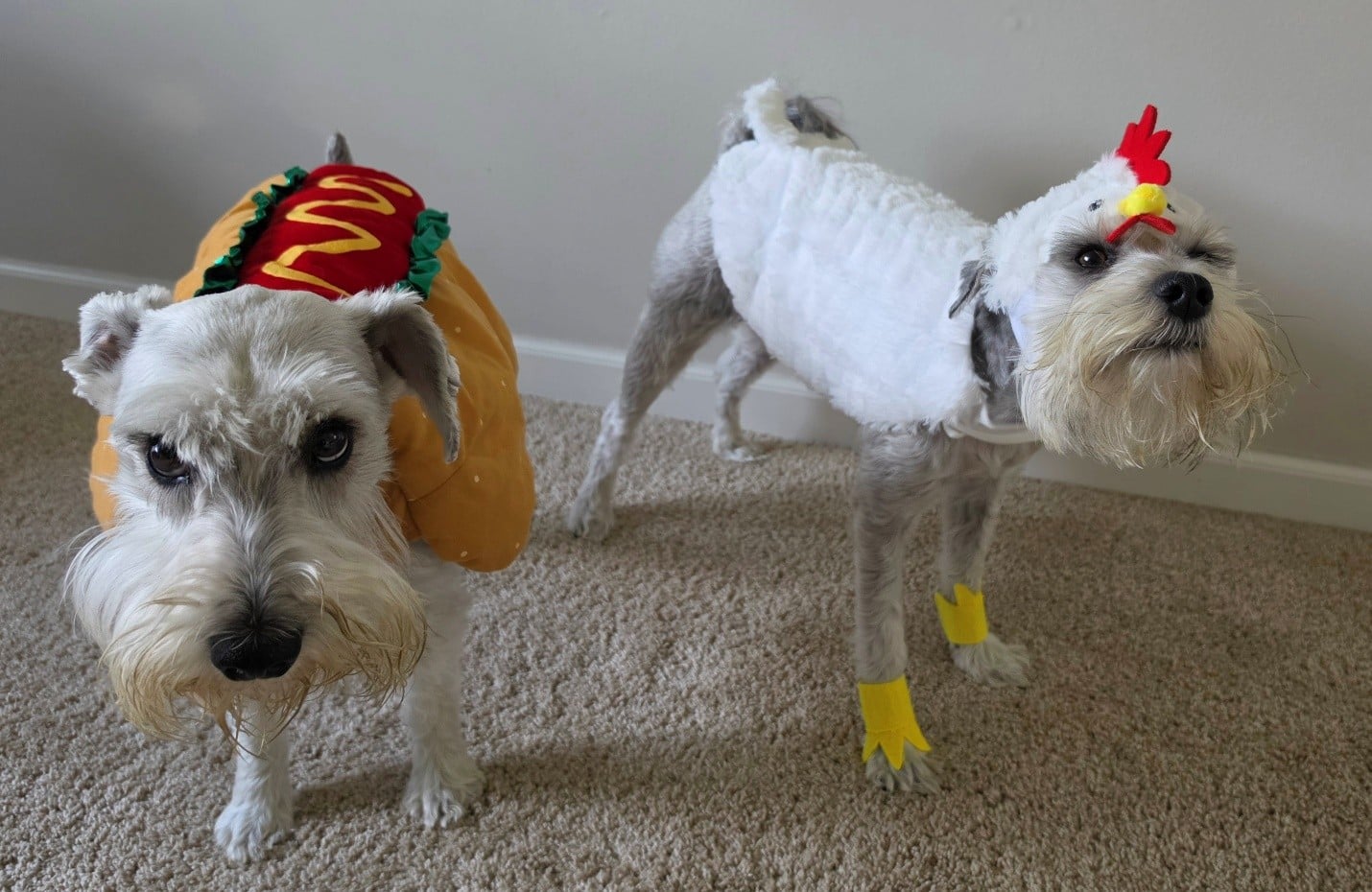
On Saturday night, while my kids work the neighborhood for treats, I'll be on the porch with one dog dressed as a chicken and the other, fittingly, as a hot dog. I'll do what I do every year: smile, compliment the costume, and ask, "What are you supposed to be?" Try the same with the next opportunity that rings your doorbell.
Happy Halloween from all of us.
Sources
1. The Associated Press, "Logan Paul's Pikachu Illustrator Pokémon card sells for record $16.5M," February 16, 2026 (via ABC7). https://abc7.com/post/logan-pauls-pikachu-illustrator-pokmon-card-sells-record-165m-auction/18609638/
2. Yahoo Sports, "Has the bubble burst on Michael Jordan's iconic 1986 Fleer rookie card?," June 3, 2021. https://sports.yahoo.com/nba-has-the-bubble-burst-on-michael-jordans-iconic-1986-fleer-rookie-card-152457795.html
3. Card Ladder, 1986 Fleer Michael Jordan #57 PSA 10 sales record, last sale October 17, 2026. https://cardladder.com/ladder/card/a81mteoQzRV9WTNHdxg9
4. ATTOM, "Q2 2026 U.S. Home Flipping Report," October 1, 2026. https://www.attomdata.com/news/market-trends/flipping/home-flipping-profits-continue-gradual-two-year-decline/
5. Joint Center for Housing Studies of Harvard University, "America's Rental Housing 2026," March 2026. https://www.jchs.harvard.edu/americas-rental-housing-2026
6. S&P Dow Jones Indices, "S&P Cotality Case-Shiller Index Reports Annual Gain in July 2026," September 29, 2026. https://press.spglobal.com/2026-09-29-S-P-Cotality-Case-Shiller-Index-Reports-Annual-Gain-in-July-2026
7. Aspen Institute Project Play, "Family spending on youth sports rises 46% over five years," March 3, 2025. https://projectplay.org/news/2025/2/24/project-play-survey-family-spending-on-youth-sports-rises-46-over-five-years
8. NCAA, "Probability of Competing Beyond High School," 2024-25 data. https://www.ncaa.org/student-athletes/probability-of-competing-beyond-high-school/