Inflation is a topic that can quickly devolve into a “when I was your age” conversation between generations. I can still remember paying less than $1 for a gallon of gas. And who can forget Subway’s “Five Dollar Footlong” campaign?
Those memories are more than nostalgia. People of different ages have experienced very different inflation environments, and those experiences can shape how they think about money and investing. Research by economists Ulrike Malmendier and Stefan Nagel has found that people’s lived experience with inflation influences their expectations about future inflation.
Here’s part of the reason why: consider what $1 from each generation's representative birth year buys today (based on the midpoint birth year of each generation):
- Silent generation — 4¢
- Baby Boomers — 8¢
- Gen X — 12¢
- Millennials — 36¢
- Gen Z — 55¢
This helps explain why two investors looking at the same economic data can come away with very different ideas about what feels safe.
But there is another reason inflation deserves a more personal look: the inflation rate reported in the news is not necessarily the inflation rate experienced by your household.
Not all prices rise at the same rate
The Consumer Price Index, or CPI, is designed to measure changes in the prices of a broad basket of goods and services. It gives us a useful shorthand for inflation across the economy.
But households do not buy that basket in equal proportions.
Since January 2000, for example, the cost of hospital services has increased far more than the overall CPI, while prices for some goods have risen much more slowly or even declined. That matters if healthcare represents a growing share of your spending.
The same principle applies to education, housing and other large expenses. A family paying college tuition and helping support an aging parent may experience inflation quite differently from a household whose spending is concentrated elsewhere.
For financial planning purposes, then, headline inflation is a starting point—not necessarily the number that matters most.
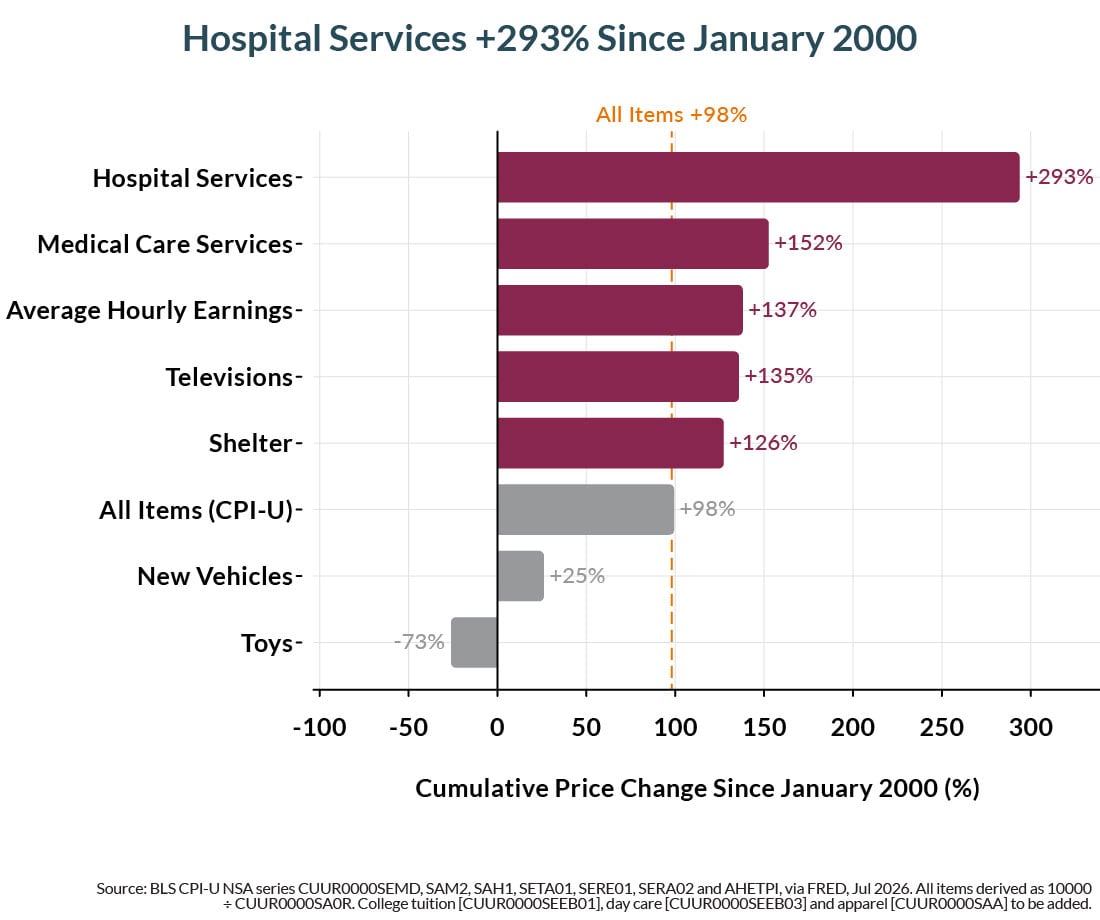
That distinction becomes especially important in retirement. Healthcare often becomes a larger share of spending as people age, and healthcare costs have historically risen at a different rate than the prices of many other goods and services.
Even broad inflation measures can reflect this difference. Since 1982, a Bureau of Labor Statistics research index designed to reflect the spending patterns of Americans age 62 and older has risen slightly faster—about 0.2 percentage points a year—than the CPI measure used to calculate Social Security cost-of-living adjustments. The difference may look small in any one year, but it can become meaningful over a long retirement.
A financial plan that assumes every expense will rise at exactly the same rate can therefore may create a false sense of precision.
Inflation also works on numbers that do not change
There is another form of inflation risk that can be easy to overlook: dollar amounts that remain fixed while everything around them becomes more expensive.
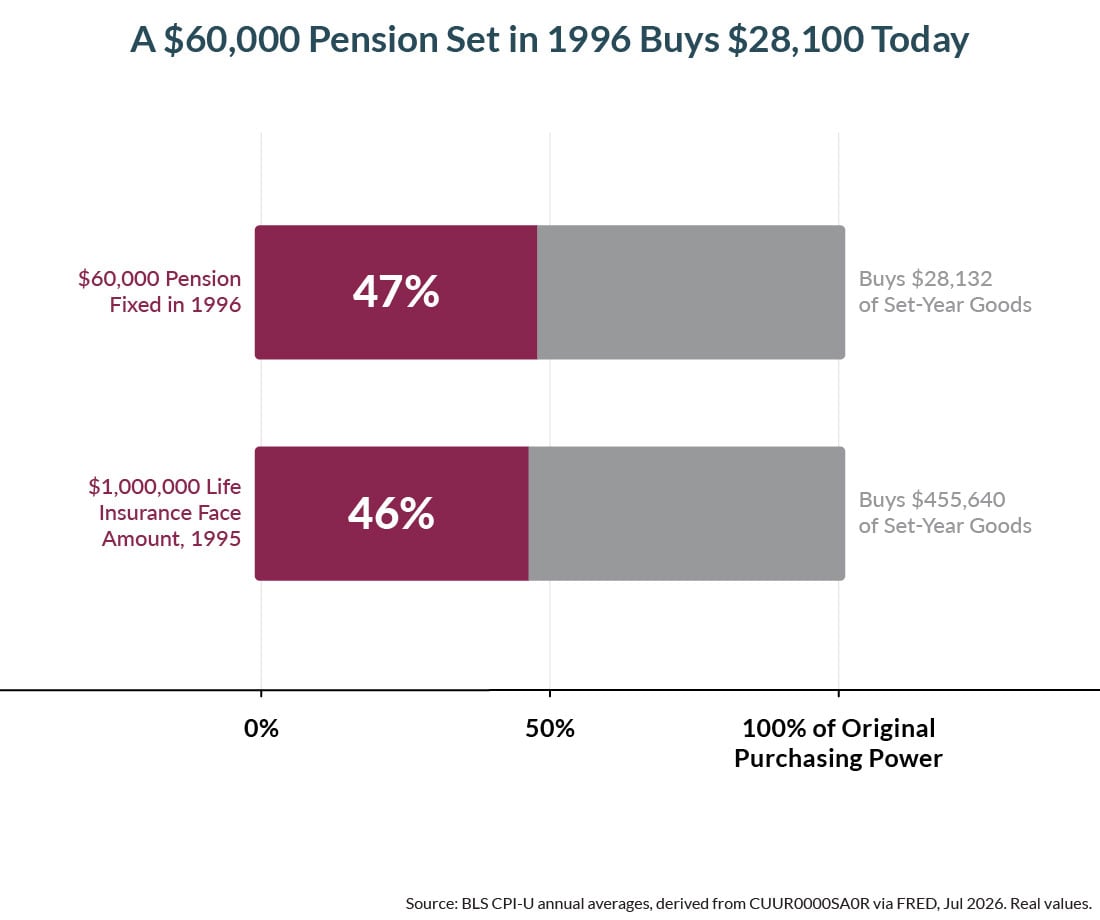
Consider a pension paying $60,000 a year. If that benefit was fixed in 1996 and never adjusted for inflation, it has only about $28,000 of its original purchasing power today.
The same issue can arise with life insurance policies, umbrella liability limits, fixed-dollar trust distributions and valuations written into older buy-sell agreements. The number printed on the document has not changed, but what that number can buy has.
Tax rules can create a similar effect. Some provisions are indexed for inflation, including federal income-tax brackets and the standard deduction. Others can remain fixed for decades. For example, the federal exclusion for gains on the sale of a primary residence—$250,000 for an individual and $500,000 for a married couple filing jointly—has not changed since 1997. As home values rise, a fixed exclusion can shelter a smaller share of the gain than it did when the limit was established.
The practical lesson is broader than any one tax provision: important dollar amounts in a financial plan should not be assumed to remain adequate simply because they were adequate when they were established.
What this means for your financial plan
Inflation planning should begin with the expenses that actually matter to you.
At Johnson Financial Group, we can model different inflation assumptions for different parts of a financial plan. Healthcare costs, education expenses and general living expenses do not necessarily need to be treated as though they will all move together.
It can also be useful to revisit important fixed-dollar amounts periodically. Does an older life insurance policy still provide the protection it was intended to provide? Are liability limits still appropriate? Do trust distributions, pension income or other fixed payments retain enough purchasing power to meet their original purpose?
These are not questions that need to be answered once and filed away.
Inflation changes gradually, and household needs change with it. That is why financial planning should be an ongoing process, with regular reviews of both the assumptions in the plan and the real-world expenses those assumptions are meant to represent.
The CPI number in the headlines may tell us something important about the economy. But for your financial plan, the more useful question may be simpler:
What is inflation doing to the things you actually need your money to pay for?