SUMMARY
Discover which strategies move the needle for 401(k) participation and how to put them to work for your workforce, whether you oversee benefits administration, plan compliance or employee compensation.
Business Guidance
6 minute read time
Discover which strategies move the needle for 401(k) participation and how to put them to work for your workforce, whether you oversee benefits administration, plan compliance or employee compensation.
fQuick answer: Employers increase 401(k) participation by combining smart plan design with clear communication. Features like automatic enrollment and deferral escalation, paired with an employer match and clear communication, simplify the process and improve retirement readiness. And thanks to the SECURE 2.0 Act, many newer plans are now required to do exactly that.
Four proven strategies do most of the heavy lifting:
Instead of asking people to sign up, the plan enrolls every eligible employee at a preset deferral rate and directs contributions into a default investment, typically a target-date fund. Employees can change their rate or opt out at any time.
The numbers are striking: Plans with automatic enrollment achieved a 94% participation rate in 2025, compared to just 64% in voluntary enrollment plans. Adoption has exploded with 61% of Vanguard plans using the feature by year-end 2025, up from just 10% in 2006. Default deferral rates are also rising: 62% of auto-enrollment plans now default employees at 4% or higher, compared to 43% in 2015.
Requirement to know: Under the SECURE 2.0 Act, most 401(k) and 403(b) plans established after December 29, 2022, must automatically enroll eligible employees beginning with the 2025 plan year. Initial deferral rates must fall between 3% and 10%, with automatic escalation up to at least 10%. Longstanding plans, small businesses with 10 or fewer employees, and companies less than three years old are generally exempt. If you sponsor a newer plan, review your setup with an advisor.
Auto-escalation automatically increases a participant's deferral rate, typically by one percentage point each year, until it reaches a set ceiling. It's especially effective when paired with annual salary increases since employees barely notice the contribution bump when their take-home pay is also rising. Without it, the savings gap that exists on day one only widens over time.
More than 70% of automatic enrollment plans now include automatic annual deferral increases and 73.6% of those escalate by one percentage point annually. Momentum keeps employees enrolled; escalation puts that same momentum to work.
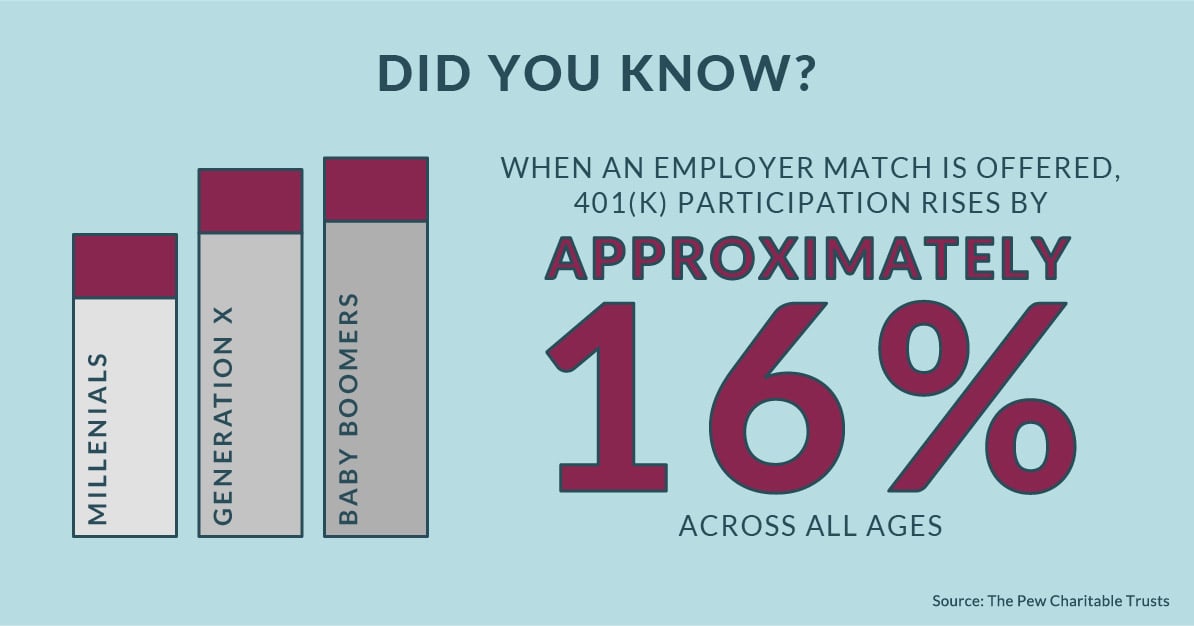
An employer match delivers an immediate return on an employee's savings — essentially free money that only kicks in if they contribute. Research by The Pew Charitable Trusts found that when a match is offered, participation rises by 15 to 16 percentage points across all age groups. More than 90% of large plans now offer employer contributions and the share of job postings mentioning a 401(k) match has more than tripled since 2020, reaching 24.7% by mid-2026.
A well-structured match also improves plan compliance. When a match formula is designed thoughtfully, it helps a plan reach a targeted overall deferral rate which can improve year-end nondiscrimination testing (the IRS-required check that ensures a 401(k) plan doesn’t unfairly favor highly compensated employees over the rest of the workforce) and ease contribution restrictions on highly compensated employees. Pairing it with a vesting schedule adds a retention benefit for the employer as well.
| Feature | What It Does | Primary Benefit to the Employer |
| Automatic Enrollment | Enrolls eligible employees by default at a preset role | Higher participation with minimal employee effort |
| Auto-escalation | Raises deferral rates ~1% per year to a ceiling | Improves long-term retirement readiness |
| Employer Match | Rewards employee contributions with company dollars | Lifts participation 15-16 points and builds loyalty |
| Vesting Schedule | Ties matched dollars to tenure | Supports employee retention |
| Financial Wellness Communication | Frames the 401(k) as part of overall well-being | Drives engagement and confident decisions |
A well-designed plan only works if employees understand and engage with it. Required disclosure documents are a start but they often create information overload rather than confidence. The plans with the strongest engagement go further — creating personalized experiences that guide employees through key decisions and supplement those with interactive online tools.
Think about how your employees actually like to learn. Some want in-person group meetings whereas others prefer video-guided online enrollment or a one-on-one conversation with a financial professional. Meeting people where they are makes a measurable difference. Leading employers have also reframed their 401(k) messaging around financial wellness as something that meaningfully improves employees' lives today and in retirement.
There is no one-size-fits-all approach. Effective communication must account for the specific demographics of your workforce with factors like age, income levels and financial literacy influencing what resonates. Working with a service provider who understands those nuances is key to moving the needle.
Automatic enrollment as it makes saving the default. Pairing it with an employer match compounds the effect further.
Many are. Under SECURE 2.0, most 401(k) and 403(b) plans created after December 29, 2022, must automatically enroll eligible employees starting with the 2025 plan year, with exemptions for small, new and longstanding plans.
Most plans start at 3% to 6% and use auto-escalation to climb over time. SECURE 2.0 requires newer mandated plans to start between 3% and 10% and escalate to at least 10%. Industry data shows 62% of plans now defaulting at 4% or higher.
A well-structured match helps a plan reach a targeted deferral rate, which can improve year-end nondiscrimination testing and ease or remove contribution restrictions on highly compensated employees.
The IRS elective deferral limit is $24,500 for 2026, plus an $8,000 catch-up for those age 50 and older. A higher "super catch-up" of $11,250 applies to employees ages 60–63 under SECURE 2.0 — already adopted by 73% of plans. Confirm current limits with your advisor, as they change annually.
Increasing 401(k) participation is the result of layering smart plan design, meaningful incentives and clear communication. The employers seeing the strongest outcomes are those who've made saving the path of least resistance for their employees.
Ready to get more out of your retirement plan for both you and your employees? Whether you're a benefits administrator navigating SECURE 2.0 compliance or a business owner looking to strengthen retention through smarter plan design, a Johnson Financial Group advisor can help. Connect with us today.
f