Financial Planning Insights
What If You Could Afford to Retire… Temporarily? 5 Questions to Consider Before a “Micro Retirement”
5 minute read time
You’ve heard of early retirement. You may have even heard of the FIRE movement (Financial Independence, Retire Early). But there’s a growing trend that sits between a sabbatical and full retirement and it’s gaining traction across all ages. It’s called “micro retirement” and it might just change the way you think about your career timeline.
What Is “Micro Retirement?”
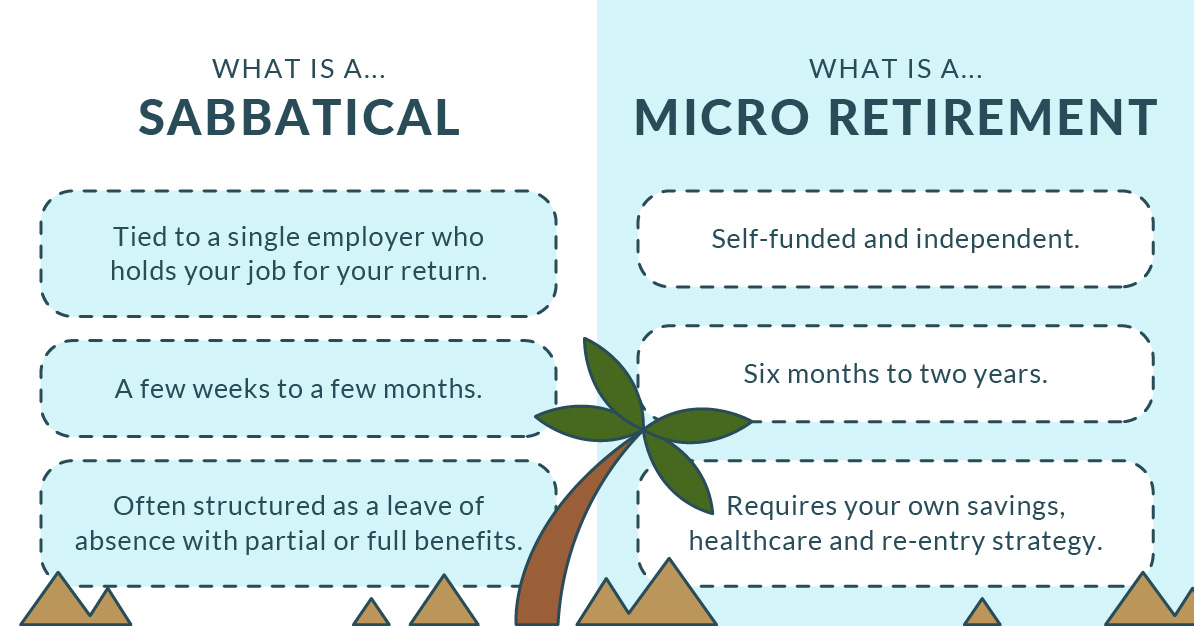
A micro retirement is a planned, self-funded career break, typically lasting anywhere from six months to two years, taken during your working years to pursue personal goals, start a business, care for loved ones or simply rest and reset. Unlike a traditional sabbatical, which is usually tied to a single employer who holds your job until you return, a micro retirement often involves stepping away from a role entirely or transitioning between career chapters on your own terms and with your own resources.
Why Would I Consider Taking One?
There are many reasons people pursue micro retirement:
- Personal Reset: A micro retirement can offer structured time to travel, study, volunteer or recharge without the pressure of squeezing it into two weeks of PTO.
- Entrepreneurship: Leaving a salaried role to launch a business is one of the most common triggers for micro retirement. It provides the runway to build something new without the financial strain of simultaneously drawing down savings and starting from scratch.
- Caregiving: Whether it's aging parents, a spouse with health needs or other family responsibilities, a micro retirement can create the space to show up for the people who need you most.
- Childcare and Family Planning: For young families, the early years of parenthood can make the cost of childcare nearly equal to the cost of stepping away. A micro retirement lets parents be present during a season that doesn't come back while keeping a path open to return to work when the timing aligns.
5 Questions to Ask Yourself Before Micro Retirement
1. How will my expenses be covered without a paycheck?
Before you do anything else, you need a clear, honest picture of how your household will function financially during the break. Start by mapping your monthly expenses. Not the aspirational version but the real one that includes the subscription you keep forgetting to cancel and the school field trip you'll inevitably need to fund. Then identify every source of funding that will replace your paycheck:
-
- Cash Reserves: Save 100% of your anticipated living expenses for the entire break, plus a three-to-six-month re-entry buffer, in liquid high-yield accounts — separate from your emergency fund.
- Spousal Income: A partner who continues working can reduce what you need to save but model it carefully. Will their income alone cover fixed costs like your mortgage, insurance and utilities? Have that conversation before you leap, not after.
- Investments: A taxable portfolio can fund a breakthrough strategic withdrawal. Work with an advisor to determine which assets to draw from and in what order, minimizing tax impact and avoiding selling during a market decline.
- Part-time Income: Consulting, freelance work or a reduced schedule can extend your break by reducing the monthly draw on savings. Just be honest about whether you're truly stepping away or simply trading one form of work for another.
2. How can I maintain my healthcare and benefits?
Lost benefits are one of the most overlooked costs of a micro retirement and often one of the most expensive. When you step away from an employer, you're not just giving up a paycheck. You're giving up health insurance, disability coverage, retirement contributions and other benefits that can be costly and complicated to replace:
-
- Medical Coverage: Leaving an employer plan means securing your own insurance. COBRA continues your existing coverage for up to 18 months but you'll pay the full premium plus a 2% fee. The ACA marketplace may offer cheaper alternatives, especially if your reduced income qualifies you for subsidies. Compare premiums, deductibles, networks and out-of-pocket maximums.
- HSA Strategy: Funds already in a Health Savings Account (HSA) can be used tax-free for qualified medical expenses during your break and you can keep contributing if you're on an HDHP. An HSA can serve as a long-term medical reserve but treat it as a safety net, not a checking account.
- Disability Protection: Group long-term disability insurance typically ends when you leave an employer. Evaluate whether to convert it to an individual policy or buy standalone coverage, especially if your break involves entrepreneurship. Your ability to earn income is your most valuable asset.
3. What happens to my long-term savings?
A micro retirement is a temporary pause in income but its effects on your long-term wealth can be permanent if you're not careful. Make sure you have a plan for the following:
-
- Missed 401(k) Contributions: While you're not working, you're not contributing to your employer-sponsored retirement plan. For someone maxing out their 401(k), that's $23,000 per year (2024) in pre-tax contributions plus the growth those contributions would have earned over the remaining years to retirement.
- Lost Employer Match: A common match is 3% to 5% of salary. For someone earning $150,000, that's $4,500 to $7,500 per year in employer contributions that won't vest during your time away. It's not just your dollars you're pausing; it's your match too.
- Reduced Compounding: The dollars you don't contribute during your break don't just disappear — they fail to compound. Over 20 or 30 years, even a single year of paused contributions can affect tens of thousands of lost growth.
- Delayed Retirement Readiness: Working with an advisor to run a cash-flow projection before you leave helps you see whether pausing contributions for 12 months requires adjusting your final retirement age by a year or two or if your existing portfolio is already doing the heavy lifting.
Pro Tip: Looking to retire early instead of pursuing a micro retirement? Download our Retirement Readiness Guide to learn how.
4. What new costs could emerge during my break?
Many people plan for the costs they're eliminating (commuting, work clothes, lunches out) without accounting for the new costs their break may introduce. It's worth thinking through these before you step away:
-
- Childcare: For emerging families, this can be the biggest variable. If you're stepping away to care for children, you may eliminate daycare costs but if your break is for entrepreneurship or personal renewal and you still need childcare, the cost may actually increase, especially if your previous employer offered a dependent care FSA or on-site childcare. Run the numbers both ways.
- Senior care: If your break is motivated by caregiving, you may reduce some senior care costs (paid care aides, assisted living) while taking on others (home modifications, transportation, medical supplies). Model both sides of the equation.
- Education costs: A micro retirement may align with a period when you're funding college tuition, private school or your own professional development. These costs don't pause just because your income does.
- Lifestyle spending: If you're traveling, pursuing hobbies or starting a business, your discretionary spending may rise, not fall. Be honest about what your lifestyle will actually cost and build it into your savings target.
5. What will it take for me to successful return to work?
Re-entering the workforce often takes three to six months longer than anticipated, especially for senior-level roles. Before your break begins, think through what a successful return looks like and what it will cost to get there:
-
- Upskilling: Depending on how long you're away and how fast your industry moves, you may need to invest in certifications, courses or training to stay current. Budget for this before you leave, not after you return, when you're already feeling the pressure to earn again.
- Networking: Maintaining your professional network during your break is one of the strongest predictors of a smooth re-entry. Set aside a small budget for conferences, memberships and events so you can stay connected without it feeling like a financial strain.
- Career Changes: Pivoting into a new role or industry may come with a temporary income reduction as you ramp up in a new direction. Plan for the pivot, not just the pause.
- Income Recovery: Your post-break income may start lower than your pre-break income, especially if you're changing roles or industries. Build a cushion of savings that carries you through the transition back to full earning capacity.
A micro retirement is about stepping away on purpose with a plan that protects everything you've worked hard to build. The five questions above all come down to one idea: Can you fund the life you want during your break without compromising the life you want after it? If the answer is yes, a micro retirement could be the right fit. If the answer is "I'm not sure," that's exactly why you should run the numbers with a financial advisor.
Ready to explore whether a micro retirement is right for you? Connect with an advisor to help you stress-test your plan, identify the gaps and build a roadmap that funds your break without derailing your future.
Frequently Asked Questions
The biggest financial risk of taking a micro retirement isn’t the temporary loss of income. It’s the long-term impact of interrupted savings, lost compounding, benefit changes and delayed wealth accumulation.
You should aim to have 100% of your anticipated living expenses for the break, plus a three-to-six-month re-entry buffer, held in liquid, accessible cash accounts separate from your traditional emergency fund. For example, if your household spends $7,000 a month and you plan to take one year off, you would want roughly $105,000 to $126,000 set aside in a high-interest savings account or money market fund so you aren't forced to sell long-term investments during a market downturn.
Pausing your income affects your long-term retirement in two ways: You temporarily stop contributing new dollars to your accounts and you pause the employer match. However, the money you have already invested continues to compound while you are away. Working with an advisor to run a cash-flow projection before you leave helps you see whether pausing contributions for 12 months requires adjusting your final retirement age by a year or two or if your existing portfolio is already doing the heavy lifting.
Re-entering the workforce often takes three to six months longer than anticipated, especially for senior-level roles. Before your break begins, build a dedicated "re-entry runway" into your cash savings, maintain your professional licenses or certifications and keep a small budget for networking or consulting projects so you can transition back on your own terms without financial pressure.